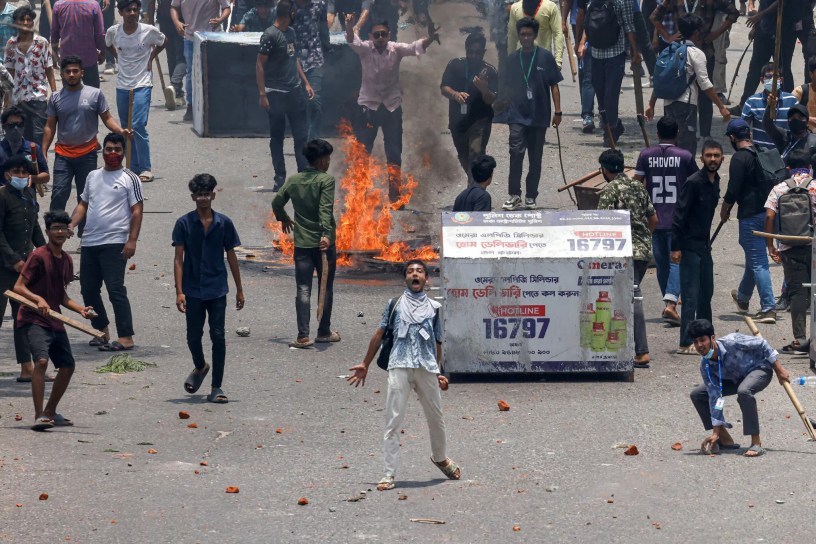
Bangladesh faces a grave crisis due to the ongoing student movement against government job quotas. Originating from the quota system established in 1972, this movement has escalated into a violent anti-government protest, resulting in 150 casualties as reported by agencies. This article delves into the historical context, recent developments, and the political implications of this crisis, seeking to uncover the root causes and potential solutions.
The crisis originates in the system of quotas for various categories of applicants for government jobs in Bangladesh. It started in 1972 when the first Prime Minister of Bangladesh, Sheikh Mujibur Rahman’s government, provided a 30% quota in government jobs to the freedom fighters who participated in the Bangladesh Liberation War. Over the years, some changes were made in the system, allocating quotas in government jobs in the following manner:
• Descendants of freedom fighters: 30%
• Women: 10%
• Residents of the concerned districts: 10%
• Tribal people: 5%
• Specially-abled persons: 1%
The remaining 44% of the jobs were unreserved.
The students’ view is that the descendants of the freedom fighters did not participate in Bangladesh’s freedom struggle and, therefore, they should be treated at par with other Bangladesh citizens concerning employment. In 2018, after Sheikh Hasina assumed power, the students organised a massive movement demanding the abolition of the quota for the descendants of the freedom fighters. Under pressure, the Hasina government removed all quotas in government jobs. According to one point of view, the Awami League was not comfortable with the abolition of the quota for the descendants of the freedom fighters, most of whom were its supporters.
The descendants of the freedom fighters challenged the 2018 government order in the High Court. In its verdict given in early June this year, the High Court Division quashed the Government’s 2018 order abolishing the quota for the descendants of the freedom fighters. The government appealed against this verdict and the Supreme Court has scheduled it for hearing on 21 July.
The present agitations by the students began as soon as the High Court’s verdict restored the quotas for the descendants of the freedom fighters. The stir was carried on under the banner of the “Students’ Movement against Discrimination,” an umbrella organisation without any political affiliation. The stir, which started in Dhaka, soon spread to other universities. Though vociferous, the students were initially protesting peacefully. To begin with, they marched within their campuses and blocked some intersections.
There have been some discussions in the media about how the movement took a sudden, violent turn.
Prime Minister Hasina was in China when the stir was rapidly spreading, and the blockades started to dislocate transportation and create problems for the common man. The Awami League leadership discussed the matter within the party to find a solution. It is learnt that a section of senior party leaders felt the opposition – the Bangladesh Nationalist Party and the Jamaat-e-Islami/ Islamic Chhatra Shibir – were behind the stir. A top leader reportedly told the meeting that he had the right solution for the problem. According to some sources, it followed from this that the Chhatra League (the student wing of the Awami League) cadre be encouraged to disperse the students and end the agitation.
Meanwhile, Hasina returned from abroad on 14 July. At a press conference, she was asked whether the quota for the descendants of the freedom fighters was being abolished. To this, she retorted, “If freedom fighters’ descendants do not get the quota, who will get it, the razakars’ descendants?”
In Bangladesh, the term “Razakar” is considered a highly objectionable word and a filthy abuse, as it is used for the most hated group of people who collaborated with the Pakistani Army and perpetrated some of the most horrendous crimes during the 1971 liberation war. Nothing would hurt the students more than being accused of being descendants of razakars. They were incensed. The wood was dry and ready. The Prime Minister’s sarcastic remark worked as the spark for it to flare up. From midnight of 15 July, students in large numbers hit the streets chanting the slogans “Who Am I? Razakar. Who has said so? The Autocrat,” and “We demanded our rights, but were branded razakars!”
From the next morning, that is on 16 July, the Chhatra League cadres allegedly descended upon the agitating students in Dhaka with sticks, choppers and even firearms “to resolve the issue politically.” Over 300 students were reportedly injured in these attacks. The attackers did not even spare those who were under treatment at the Dhaka Medical College Hospital. They twisted the students’ slogans to claim that the agitators were indeed descendants of razakars, who deserved a lesson.
The news of organised attacks on students by the Chhatra League cadre spread like wildfire across the country. Now it was for the general body of the students to “teach the goons a lesson.” At almost every university campus the Chhatra League workers were flushed out and attacked by the anti-quota agitators. The students also called for a nationwide shutdown on 18 July. On that day, people other than students reportedly joined the agitation. This turned the whole country into a battlefield. Large-scale arson and destruction of property were reported from every corner of the country. The police and the Border Guards Bangladesh, who were called in by then, could not control the situation. Some reports attribute many of the deaths to police firing.
Despite the deployment of the Police, Rapid Action Brigade and the Bangladesh Border Guards, the situation went out of control. The government called out the Army to maintain law and order, clamped a nationwide curfew, and shut down internet services. All educational and other institutions were closed down. As the death toll has kept mounting despite these prohibitory measures, the government ordered the army to shoot anyone at sight during the curfew hours.
The country is now virtually cut off from the rest of the world. According to news that is trickling in, armoured vehicles and tanks are patrolling the streets of Dhaka and elsewhere, which is reminiscent of the Pakistani crackdown in 1971 on those demanding autonomy for the then East Pakistan. A similar situation prevails in the rest of the country.
Nahid Islam, spokesperson of the Students’ Movement Against Discrimination announced that their movement was completely apolitical, and their only demand was that the government reformed the quota in jobs. He categorically stated that the students were in no way associated with those who indulged in arson and destruction of properties.
The Police claimed that Islami Chhatra Shibir, the student wing of the Jamaat-e-Islami infiltrated the students’ movement and indulged in subversive activities. It is learnt that the intelligence agencies of Bangladesh have also reported that the opposition Bangladesh Nationalist Party (BNP) and JEI took full advantage of the façade of a students’ agitation and seized the opportunity to try and topple the government by violent means.
These allegations and assumptions may as well be true, but not unexpected, as the government has not allowed much space for its opponents in the political arena. It is not unusual for them to look for opportunities to fish in troubled waters. Furthermore, from how the events unfolded, it is clear that the Awami League failed to demonstrate the sagacity, maturity, and patience expected of a party in power for the last fifteen years without a break.
Its student wing in particular should have picked up the murmur of discontent within the student community and, instead of taking the law into its own hands as alleged, should have conveyed the same to the party bosses for effective, consultative, and non-violent measures to defuse the tension that was building up.
The United Nations expressed its concern over the loss of lives in Bangladesh. Any loss of life is regrettable. However, it should be remembered that the agitation by students against the government and the action taken by the latter to maintain the rule of law are internal matters of that country, and Bangladesh is quite capable of handling the situation without any outside intervention to queer the pitch. India has correctly taken this position.
The government eventually took measures that were a mix of stern action against the violence, and reconciliatory steps to find a solution to the issue that would be acceptable to all sides. While the police arrested Nahid Islam, the chief coordinator of the Students’ Movement against Discrimination, talks also reportedly began between government officials and some student leaders.
Meanwhile, after hearing all sides, the Supreme Court has given its verdict, prescribing a 7% quota in government jobs. 5 per cent of this will be for the descendants of the freedom fighters and the remaining 2 per cent for other designated categories. The court has also told the students to call off their agitation and return to their campuses.
Some analysts have observed that the agitation showed that the “Liberation War” and “Freedom Fighters” do not resonate much with the new generation. This does not seem to be correct. If it were true, the word “razakar”, first heard in Bangladesh during the liberation war, would not have stirred up such a passion. Freedom Fighters and the 1971 war still evoke considerable patriotic feelings among Bangladeshis; the intensity has waned over the past 53 years.
When Sheikh Mujib first introduced the 30 per cent quota for the freedom fighters, there was justification for the same. Before and after Bangladesh became free in 1971, a large number of civil servants left their administrative and other jobs and went back to West Pakistan. There was an acute shortage of qualified people to fill those vacancies.
Also, it is believed that following Bangladesh’s liberation, Marshal Tito advised Bangabandhu to use the freedom fighters in the country’s reconstruction as, ‘even if they make mistakes, their heart is at the right place.’ Be that as it may, to continue with the high quota for the grandchildren of the freedom fighters after 53 years of independence is somewhat inexplicable. Critics of the Awami League say that the party did not want to displease its vote bank, viz. the descendants of the freedom fighters. If this assumption is correct, the latest Supreme Court judgement may have come as a boon in disguise.
Prime Minister Hasina has put the entire blame for the violence and the loss of life and property on the BNP, the Jamaat-e-Islami and its militant student wing, the Islami Chhatra Shibir. She condemned the loss of life but said that given the intensity of the violence she was forced to impose a curfew and deploy the Army.
Political analysts believe that Hasina is not entirely wrong. However, they also point out that discontent has been simmering among a large section of the population because, in consecutive parliamentary elections, the ruling Awami denied the people their basic right to elect representatives of their choice. Anger also built up because Hasina denied any legitimate space to the opposition in the political arena. The anti-quota agitation perhaps came ruse for them to vent their built-up anger and discontent.
The only long-term solution that can stop such periodic boiling over of pent-up discontent of the people from time to time is having a truly representative government in power, with robust opposition. For that to happen, the Awami League and the Opposition both must introspect, hold serious talks among themselves with an open mind, and find an acceptable way forward.
The situation in Bangladesh is still tense, and sporadic violence is being reported. The internet is still not working. The students have vowed to seek justice for those killed in alleged police firings on protesters. Eventually, the agitation will lose steam following the Supreme Court verdict and normalcy will hopefully return to Bangladesh.
Nothing can, however, replenish the loss of the bereaved families. That is the saddest part of this entire unfortunate episode. It is more painful because, with a little prudence, this was avoidable.
23 Jul 2024
Photo credit: NYT – Internet
 Sandip's Musings