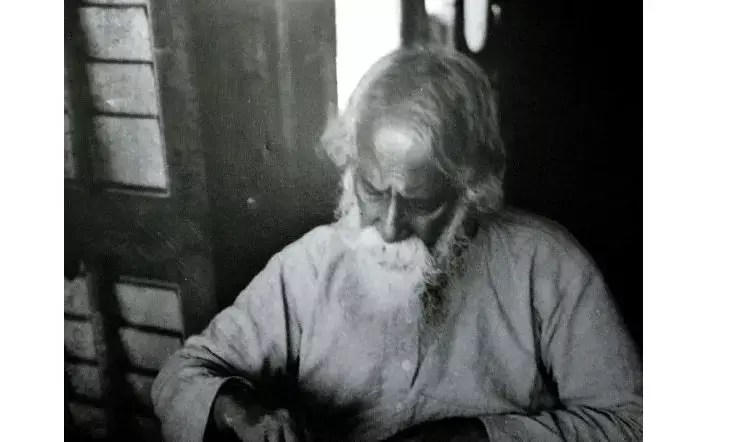
22nd Shravan in the Bengali calendar was the death anniversary of Rabindranath Tagore, the Poet of India. Yet being a poet and a Nobel Laureate was only a fraction of what Tagore was.
Primarily a poet and composer of songs that continue to reverberate in the Bengali psyche, Tagore’s music possesses a philosophical depth that is only now beginning to be explored more fully.
But Rabindranath was also arguably the greatest Bengali short-story writer, with critics placing some of his work in the company of, and at times even above, that of Chekhov. He was an accomplished novelist, a pioneer of musical theatre and a dramatist who, even today, has few parallels in India. His essays on a wide variety of subjects, including the Upanishads, continue to be studied and appreciated by scholars across the world.
He was, above all, a great philosopher, drawing deeply from the wisdom of the Upanishads. Their profoundly humanist message, articulated by him at a particularly troubled moment in human history, seemed almost like a divine revelation.
A rationalist and a lover of science, Rabindranath wrote a remarkable book on popular science, Vishwa Parichay. He also engaged in a prolonged exchange of views with Mahatma Gandhi over the cause and meaning of the great Bihar earthquake of 1934.
Gandhi believed that the earthquake could be seen as a divine retribution for the terrible oppression and caste practices prevalent in Bihar. Tagore vehemently opposed this interpretation. An earthquake, he argued, had a scientific explanation, and there was no justification for attributing a natural phenomenon to divine intervention.
Their exchanges subsequently appeared in the form of a booklet, Truth Called Them Differently: The Tagore-Gandhi Controversy, edited by Krishna Kripalani.
Tagore was by no means blind to the tyranny of British rule. He was unsparing in his criticism of the colonial authorities and condemned their oppression of India’s freedom fighters through his poems, essays and letters, including correspondence addressed to the highest authorities of the British government. His renunciation of the knighthood following the Jallianwala Bagh massacre remains one of the most powerful gestures of moral protest in the history of India’s freedom movement.
Tagore was also an educationist. His conception of education, like that of his great contemporary Swami Vivekananda, was that it should bring out the best in the student rather than merely fill the mind with information. With this objective, he established the Brahmacharya Vidyalaya at Santiniketan and later developed it into Visva-Bharati, a university conceived as a meeting place of cultures and civilisations. Its motto, “यत्र विश्वं भवत्येकनीडम्” — “Where the world makes a home in a single nest” — beautifully expressed his vision of an India open to, and enriched by, the world.
Tagore, although a patriot to his core – as reflected in a large number of his compositions – abhorred narrow nationalism that blind people to the broader bonding based on humanism. He never believed in “my country right or wrong,” or that even in war a country should treat the people of another as sub-humans.
In defending this principle, Tagore engaged in lengthy exchange of letters with the Japanese poet Yone Noguchi in 1938 when imperialist Japan attacked China in 1937, in what was the beginning of the tragedies of the Second Sino-Japanese War. Tagore was vehement and scathing in his condemnation of Japanese violence over the Chinese people.
Although Tagore had himself seen and admired Japan’s admirable economic progress and technological development and felt that other Asian nations could learn from Japan, when reports of Japanese atrocities in occupied China and its attacks on China’s ancient and rich cultural heritage, he was deeply pained and was unsparing in denouncing such actions.
A true polymath, Tagore took to painting at the age of seventy. It was almost as though, having exhausted the possibilities of words, he had moved on to the brush, charcoal, pencil and pen to express thoughts and emotions that could no longer be contained in language. And, remarkably, this late artistic endeavour too won him international recognition and admiration.
Unfortunately, because of the paucity of translations, much of Tagore’s enormous body of work — spread over some thirty substantial volumes in the standard Bengali editions — remains inaccessible to those whose mother tongue is not Bengali. Outside Bengal, this extraordinary man is still known primarily as the author of India’s National Anthem and as the poet of Gitanjali, for which he was awarded the Nobel Prize in Literature in 1913, becoming the first Asian recipient of the prize.
Beyond Gitanjali and a few other volumes of poetry that have been translated into Hindi and some other major Indian languages, however, the vast treasure trove of Tagore’s writings remains largely inaccessible to the ordinary, educated, non-Bengali-speaking Indian. This is so even though a large number of scholars, both in India and abroad, have devoted their lives to researching Tagore and continue to do so.
One can only hope that, as more Indians learn one another’s languages, and the country becomes more closely integrated — as Tagore so earnestly desired — the rest of India will discover more of this extraordinary man. And perhaps, like generations of scholars before them, ordinary Indians too will marvel that, barely a century and a half ago, Mother India gave birth to a human being of such astonishing intellectual, artistic and spiritual range — someone of whom the entire nation can truly be proud.
Rabindranath Tagore Unparalleled: Far More Than a Poet and Nobel Laureate