
As India celebrates its 80th Independence Day, the nation is once again wrapped in patriotic fervour. We remember the millions of freedom fighters whose struggle and sacrifice culminated in independence after nearly two centuries of British rule. Every year on this day, the country is, so to speak, bedecked with our National Flag—the Tricolour, as we lovingly and reverentially call it. The Prime Minister has called upon every household to fly the flag as a mark of love for the motherland. This is therefore an appropriate occasion to trace the fascinating journey through which the Tricolour evolved and was eventually adopted as India’s National Flag.
Our ancient literature and history refer to the vast geographical entity of Bharata Varsha or Jambudweepa, extending from the Himalayas in the north to the ocean in the south. Yet even its greatest empires were not unified in the modern sense. Powerful rulers and dynasties often exercised suzerainty over numerous smaller kingdoms, which retained considerable autonomy within their own territories.
These empires and kingdoms had their own flags, used in peace and war. But there is no evidence of a single flag representing the whole of Bharata Varsha or, later, Hindustan. The very idea of a national flag therefore belongs to a much more recent age. It acquired significance with the emergence of Indian nationalism in the late nineteenth century and the growing demand for a greater Indian role in governance. The formation of the Indian National Congress in 1885 was an important early milestone in that process.
The evolution of India’s National Flag thus mirrors the country’s freedom struggle. It was not created overnight, but evolved over several decades through successive political awakenings, designs and ideological shifts. A national flag was more than a piece of cloth: it was to give a diverse people a common identity and a symbol around which the nation could unite. The evolution may broadly be seen in three stages: the early nationalist designs of 1904–17; the flag developed by Pingali Venkayya, which became the basis of the 1931 Swaraj Flag; and finally, the Tricolour adopted by the Constituent Assembly in 1947.
As Indian nationalism gathered momentum, particularly during the anti-Partition and Swadeshi movements, the search for such a symbol began to take concrete form.
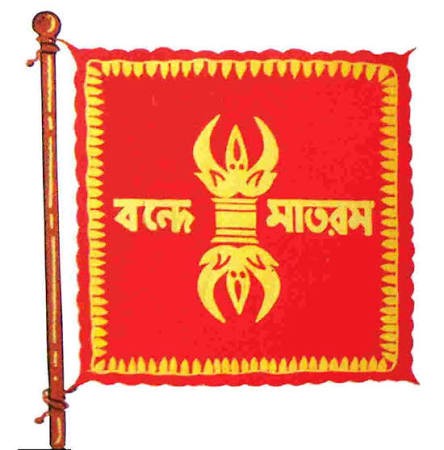
Sister Nivedita, the Irish disciple of Swami Vivekananda, designed one of the earliest such flags. In a 1905 letter to Josephine MacLeod, she wrote that a design for a National Flag had been chosen—the Vajra, or thunderbolt. She later elaborated on the idea in an article, “The Vajra as a National Flag”, published in the Modern Review in November 1909.
Her square red-and-yellow silk flag featured a yellow vajra, a white lotus and the words Vande Mataram in Bengali script. It was displayed publicly at an industrial and agricultural exhibition during the Calcutta Congress session in December 1906. The century-old original, restored by INTACH, is preserved at Acharya Bhavan, the residence of Acharya Jagadish Chandra Bose, in Kolkata.
In 1907, Sachindra Prasad Bose and Hemchandra Kanungo designed what came to be known as the Calcutta Flag, which was unfurled at Parsi Bagan Square in Calcutta. It was a tricolour of green, yellow and red, carrying lotus flowers, Vande Mataram, and symbols of the sun and crescent moon. The same year, Madame Bhikaji Cama hoisted a closely related flag at Stuttgart, Germany, at a meeting of the Socialist International.
During the Home Rule Movement, Lokmanya Tilak and Dr Annie Besant used another design, consisting of alternating red and green stripes, the Saptarishi constellation, and the Union Jack alongside a crescent and star. Since the movement demanded Home Rule rather than complete independence, the presence of the Union Jack was perhaps understandable. It was, however, inconceivable that such a symbol could form part of the flag of a free India.
The real precursor of the present Tricolour was the flag designed by Pingali Venkayya. A multifaceted personality from Andhra Pradesh with a fascination for flags, Venkayya presented Mahatma Gandhi with a design at the 1921 session of the All-India Congress Committee at Vijayawada (then Bezwada). It consisted of red and green, representing Hindus and Muslims. Gandhiji suggested adding a white stripe to represent the remaining communities and a spinning wheel, or charkha, at the centre. The charkha symbolised economic self-reliance, the dignity of labour and the freedom movement.
In 1931, the design underwent a significant transformation. The colours were changed to saffron, white and green, while their earlier communal interpretation was abandoned. Saffron represented courage and sacrifice, white peace and truth, and green faith and fertility. The charkha remained at the centre. The resulting Swaraj Flag became the unofficial standard of the freedom movement and was carried by satyagrahis across the country.
As independence approached, a committee headed by Dr Rajendra Prasad, with Maulana Abul Kalam Azad, Sarojini Naidu and K.M. Panikkar among its members, considered the flag for independent India. Its recommendation was accepted by the Constituent Assembly, which adopted the National Flag on 22 July 1947.
The three colours of the 1931 flag were retained, but the charkha was replaced by the Ashoka Chakra—the Dharma Chakra, or Wheel of Law—derived from the Lion Capital of Ashoka at Sarnath. The navy-blue wheel, with its 24 spokes, symbolised the dynamic nature of peaceful change, progress and righteousness. The change was significant. The flag was no longer associated with a political party or a particular phase of the freedom struggle. Instead, it drew upon India’s ancient civilisational heritage while retaining the essential character of the nationalist Tricolour.

The journey, however, was not without controversy. One of the most notable objections came from the Rashtriya Swayamsevak Sangh (RSS). On 14 August 1947, its mouthpiece, Organiser, carried a sharply critical editorial:
“The people who have come to power by the kick of fate may give in our hands the Tricolour, but it will never be respected and owned by Hindus. The word three is in itself an evil, and a flag having three colours will certainly produce a very bad psychological effect and is injurious to a country.”
M.S. Golwalkar, the second Sarsanghchalak of the RSS, expressed a similar view in Bunch of Thoughts, in a chapter significantly titled “Drifting and Drifting”: “Our leaders have set up a new flag for our country. Why did they do so? It is just a case of drifting and imitating…. Ours is an ancient and great nation with a glorious past. Then, had we no flag of our own? Had we no national emblem at all these thousands of years? Undoubtedly, we had. Then why this utter void, this utter vacuum in our minds?”
But that was eight decades ago—a long time in the life of a nation, and certainly long enough for individuals and organisations to change their views.
The Tricolour has, meanwhile, stood the test of time. For eight decades, Indians across political, religious and social divides have embraced it as the symbol of the Republic. It has flown over Parliament, schools and homes; been carried by soldiers into battle and by athletes to the world’s highest podiums; and, most importantly, become part of the everyday emotional landscape of India. If the Prime Minister’s call for every Indian household to fly the Tricolour reflects a genuine and wholehearted acceptance of the National Flag across the political spectrum—including within the Sangh Parivar—that is a welcome transition indeed.
After all, the journey of the Tricolour is ultimately the story of India itself: a journey from competing identities towards a shared national symbol, forged in the struggle for freedom and sustained by the generations that followed.

