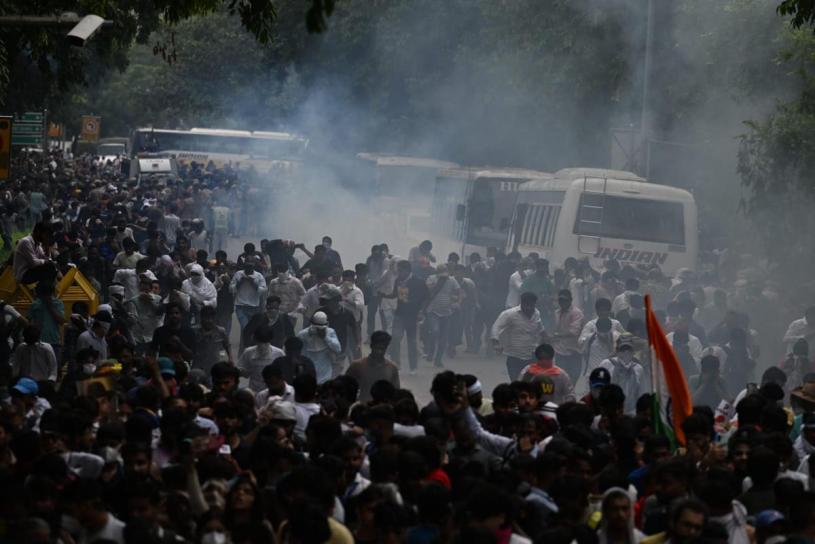
When the NEET paper leak scandal shattered the aspirations of thousands of students, the government responded with familiar promises of “stringent action” while resisting demands for accountability within the Ministry of Education and the National Testing Agency (NTA). Calls for a comprehensive overhaul of the NTA fell on deaf ears. Instead, the agency announced a retest, and the government even deployed Indian Air Force aircraft to transport question papers across the country—a move that invited widespread ridicule.
It was at this juncture that the Cockroach Janata Party (CJP) emerged, inspired by a caustic remark from the Chief Justice of India. Almost overnight, the new outfit captured the imagination of the country’s youth. A massive protest was announced at Delhi’s Jantar Mantar, followed by a march towards Parliament.
Despite brutal police crackdowns, the use of pellet guns, and the forcible removal of environmentalist Sonam Wangchuk from his indefinite fast, the agitation intensified as more youths joined the ranks.
Under mounting public pressure, the government finally reached out to the CJP. After several rounds of talks:
- The education minister resigned.
- The government agreed to withdraw FIRs filed against protesters.
- The Prime Minister assured accelerated trials and harsher punishments for paper leak offenders.
- Several NTA officials were suspended under public pressure.
On July 30, Parliament passed the Public Examinations (Prevention of Unfair Means) Amendment Bill, 2026. While touted as a panacea, the legislation merely enhances penalties without addressing the systemic weaknesses of the testing apparatus.
The government faltered on multiple fronts throughout the crisis:
- It played down years of recurring leaks and shielded NTA bureaucrats guilty of dereliction of duty.
- It treated the mass movement as a routine law-and-order issue rather than addressing underlying frustrations.
- The heavy-handed police response severely dented the administration’s image.
The government and the ruling party were caught napping by the CJP protest. They thought the “upstart” movement, whose grassroots support was negligible, would not withstand a strong-arm action. In the end, however, it was the BJP’s carefully cultivated aura of invincibility that suffered the greater blow.
While the BJP’s IT cell and Delhi Police shifted focus to damage control—highlighting vulgar abuses hurled at the Prime Minister and searching for a “larger conspiracy”—the deeper anger of the younger generation remained unaddressed.
The Prime Minister eventually pardoned the girl for her outburst. Yet the wiser course from the outset would have been to ignore it. Gen Z inhabits a far more permissive cultural environment than older generations. Profanity that is ignored usually burns itself out; outrage amplified by those in authority often acquires a life of its own.
The CJP protest was much more than a student agitation against examination malpractices; it was an outlet for the educated, jobless youth to vent their pent-up angst. Surprisingly, the ruling party’s political antennae failed to pick up the seismic tremors before the eruption.
Seizing the opportunity, the Opposition displayed a rare unity in standing with affected students and families, and cornering the government in Parliament and on the streets.
The true significance of the movement extends far beyond politics; it highlights a fundamental crisis in India’s educational trajectory. Education is not only about entrance tests for joining colleges and universities. Education should produce responsible, broad-minded citizens rather than merely producing compliance-driven cogs for industry.
Instead, not only are conscious efforts underway to instil partisan ideologies into impressionable minds at the school level, but even universities – traditionally bastions of free inquiry and fearless debate – face regimentation where dissent is punished, and advisories are issued to deter student activism so as not to “…embarrass the relation between the Institute and the Central Government, other organisations or the public.”
History shows that student movements often begin around a specific grievance but acquire wider political significance when they tap into accumulated frustration. From the anti-corruption movement of the 1970s to more recent campus agitations, governments have repeatedly underestimated the capacity of educated youth to transform local anger into a broader demand for accountability. The CJP appears to belong to that tradition.
The CJP agitation exposed a widening disconnect between a government convinced of its own invincibility and a generation demanding competence, accountability, and the freedom to question authority. A nation that suppresses independent thinking in its classrooms may produce compliant subjects, but it will never cultivate confident citizens. That is the real challenge confronting India today.
 Sandip's Musings